



Before an internal thread is cut or formed, the tap drill hole has to be right. If it is too small, the tap jams or breaks. If it is too large, the threads lack their crests and the screw holds less. With a simple formula you can find the right drill for any metric thread – including fine threads that are not in any short chart.
The rule of thumb for tapping
- dB tap drill diameter (drill diameter) in mm
- d nominal diameter of the thread in mm
- P pitch in mm
Round the result to a drill size you can actually buy. Up to 4 mm, drills usually come in 0.05 mm steps, above that in 0.1 mm steps. If the value lies exactly between two steps, both neighbouring drills will work. The usual choices are 6.8 mm for M8 (calculated 6.75 mm) and 10.2 mm for M12 (calculated 10.25 mm).
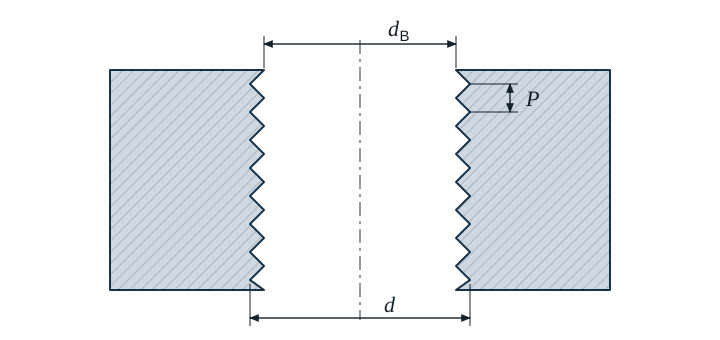
Example with M10
Example
An M10 thread is to be cut with a tap. The coarse pitch of M10 is 1.5 mm.
dB = 10 mm − 1.5 mm = 8.5 mm
Drill with 8.5 mm. Then countersink at 90° to about 10 mm so that the tap starts straight and no burr is thrown up at the edge.
Chart for metric coarse threads
Form taps do not cut, they press the material into the thread shape. That is why they need a larger pilot hole. The values for forming are guide values; the tool manufacturer's specification takes priority.
| Threads | Pitch P | Tap drill for cutting | Pilot hole for forming (guide value) | Countersink to approx. |
|---|---|---|---|---|
| M3 | 0,5 | 2,5 | 2,8 | 3,0 |
| M4 | 0,7 | 3,3 | 3,7 | 4,0 |
| M5 | 0,8 | 4,2 | 4,6 | 5,0 |
| M6 | 1 | 5,0 | 5,6 | 6,0 |
| M8 | 1,25 | 6,8 | 7,4 | 8,0 |
| M10 | 1,5 | 8,5 | 9,3 | 10,0 |
| M12 | 1,75 | 10,2 | 11,2 | 12,0 |
| M16 | 2 | 14,0 | 15,1 | 16,0 |
| M20 | 2,5 | 17,5 | 18,9 | 20,0 |
| M24 | 3 | 21,0 | 22,7 | 24,0 |
All dimensions in mm. For forming, Gesello uses the guide value d − 0.45 · P and rounds to 0.1 mm.
Fine threads – the pitch makes the difference
With fine threads, the pitch is part of the designation, for example M10 × 1. Exactly this pitch goes into the formula, not the coarse pitch.
| Threads | Tap drill for cutting | Pilot hole for forming (guide value) |
|---|---|---|
| M8 × 1 | 7,0 | 7,6 |
| M10 × 1 | 9,0 | 9,6 |
| M10 × 1.25 | 8,8 | 9,4 |
| M12 × 1.5 | 10,5 | 11,3 |
| M16 × 1.5 | 14,5 | 15,3 |
How deep does the blind hole need to be?
A tap has a chamfer at the front that does not yet produce a full thread. On top of that comes the drill point. The drilling depth is therefore made up of three parts: the usable thread length, the run-out for the chamfer and the point of the drill. With a 118° point angle, the point is about 0.3 · dB long. How much run-out you need depends on the pitch and the chamfer form – Gesello calculates the drilling depth to suit the pitch.
Common mistakes
- Coarse pitch used for a fine thread: an M10 × 1 thread needs 9.0 mm, not 8.5 mm.
- Forming hole and cutting hole mixed up: a form tap in a hole that is too small breaks very quickly.
- Not countersunk: the first thread is torn out and the tap starts at an angle.
- Blind hole too shallow: chamfer and drill point forgotten, the tap hits the bottom.
- Inch threads converted incorrectly: for UNC and UNF the pitch is given in threads per inch. The pitch in mm is 25.4 divided by the number of threads.
Frequently asked questions
Why does d − P work even though the minor diameter is smaller?
The tap drill hole is deliberately a little larger than the standard minor diameter of the internal thread. The thread still carries almost as well, but the tap runs more easily and breaks less often.
Does the formula also apply to Whitworth or pipe threads?
No. The rule of thumb is meant for threads with a 60° flank angle, i.e. metric ISO threads and, by analogy, UNC and UNF. Whitworth and pipe threads have a 55° flank angle and their own tap drill values.