



The cutting speed tells you how fast the cutting edge moves through the material. On the machine, however, you can only set the spindle speed and the feed. Here you can see how to get from cutting speed to spindle speed, from feed per tooth to table feed and finally to the time the cut takes.
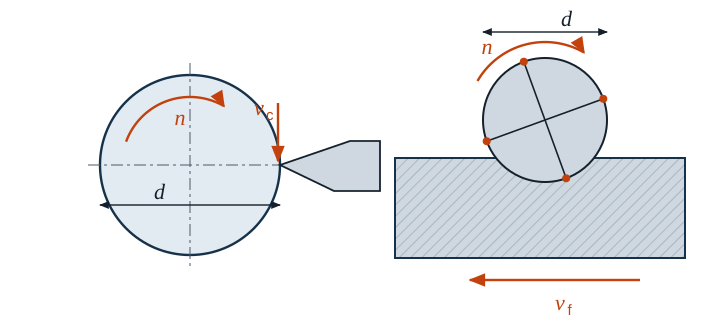
Spindle speed from cutting speed
In one revolution, a point on the circumference travels the distance π · d. Multiplied by the spindle speed, this gives the cutting speed. Because vc is given in m/min and d in mm, the factor 1000 appears in the formula:
- n spindle speed in 1/min
- vc cutting speed in m/min
- d diameter in mm (workpiece diameter for turning, tool diameter for milling and drilling)
Feed rate
For turning and drilling you state the feed f per revolution. In milling, several cutting edges share the work, so you calculate with the feed per tooth:
- vf feed rate in mm/min
- f feed per revolution in mm
- fz feed per tooth in mm, z number of cutting edges
Machining time
The time in which chips are actually produced follows from the travel and the feed rate. The travel also includes approach and overrun, and for milling usually the cutter diameter as well.
- th machining time in min
- L feed travel in mm, i number of cuts
Turning example
A shaft made of S235 with Ø 60 mm is rough-turned over a length of 80 mm with a carbide insert. The chosen values are vc = 180 m/min and f = 0.25 mm.
n = 180 · 1000π · 60 ≈ 955 1/min
vf = 0.25 mm · 955 1/min ≈ 239 mm/min
th = 80 mm · 1239 mm/min ≈ 0.33 min ≈ 20 s
If the machine has fixed speed steps, take the next lower step. The cutting speed then stays below the chosen value, which is kinder to the cutting edge.
Milling example
A slot is milled with a solid carbide end mill with 4 cutting edges (Ø 12 mm; vc = 160 m/min; fz = 0.05 mm). The slot runs through the entire workpiece length of 100 mm, so the cutter diameter is part of the travel.
n = 160 · 1000π · 12 ≈ 4244 1/min
vf = 0.05 mm · 4 · 4244 1/min ≈ 849 mm/min
th = (100 mm + 12 mm) · 1849 mm/min ≈ 0.132 min ≈ 8 s
Guide values to get started
The cutting speed depends on the material, cutting material, coolant and machine. The following ranges are guide values for carbide. Start at the lower end and work your way up. The tool manufacturer's specifications always take precedence.
| Material | Rough turning vc | Finish turning vc | End mill vc | End mill fz |
|---|---|---|---|---|
| Structural steel, e.g. S235 | 180–280 | 220–350 | 150–220 | 0,05–0,10 |
| Stainless steel, austenitic | 120–190 | 150–230 | 70–120 | 0,03–0,06 |
| Wrought aluminium alloy | 400–800 | 500–1000 | 300–600 | 0,05–0,12 |
vc in m/min, fz in mm.
Common mistakes
- Factor 1000 forgotten: the spindle speed then comes out a thousand times too small.
- Radius instead of diameter: with the radius, the spindle speed doubles and the cutting edge wears out immediately.
- Number of cutting edges forgotten when milling: if you only calculate fz · n, with four cutting edges you run at only a quarter of the feed and the edges rub instead of cutting.
- f and fz mixed up: in milling, the feed per revolution is z times the feed per tooth.
- Wrong diameter for facing: at a fixed spindle speed, calculate with the largest diameter, otherwise the cutting speed on the outside is too high.
- Travel without approach and overrun: the machining time is underestimated.
Frequently asked questions
Why not calculate directly with the spindle speed?
Because the cutting edge “feels” the cutting speed, not the spindle speed. A large diameter needs a much lower spindle speed than a small one for the same cutting speed. That is why guide values are always given for vc.
Can I calculate backwards too?
Yes. If you rearrange the formula, you can for example get the actual cutting speed from an existing spindle speed. In Gesello you simply enter the values you know and the missing ones are calculated.