



A bolt only holds a joint together securely if it gets the right preload. Too little, and the joint works loose or fails through alternating load. Too much, and the bolt is overstretched. The tightening torque is how you get there – and it depends more on lubrication than most people think.
What the property class tells you
The head of a steel bolt carries two numbers separated by a dot, for example 8.8. You can read the strength straight from them:
- The first number times 100 gives the tensile strength Rm in N/mm². For 8.8 that is 800 N/mm².
- First times second number times 10 gives the yield strength Re in N/mm². For 8.8 that is 8 · 8 · 10 = 640 N/mm².
| Property class | Tensile strength Rm | Yield strength Re | matching nut |
|---|---|---|---|
| 8.8 | 800 N/mm² | 640 N/mm² | at least class 8 |
| 10.9 | 1000 N/mm² | 900 N/mm² | at least class 10 |
| 12.9 | 1200 N/mm² | 1080 N/mm² | at least class 12 |
The class numbers give nominal values. For 10.9 and 12.9 the standard specifies a slightly higher minimum proof strength (940 and 1100 N/mm²). The torques below are calculated with these values.
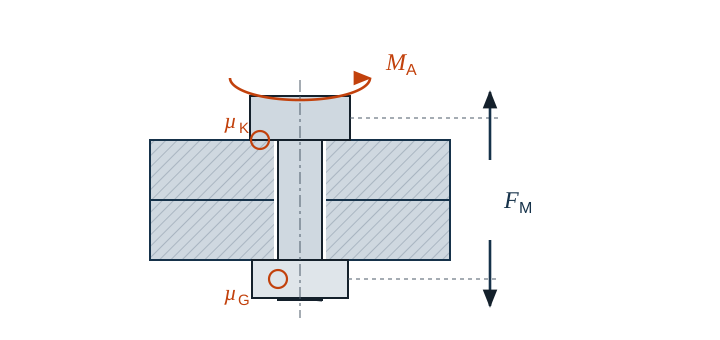
Guide values for tightening torques
The table applies to hexagon head bolts with metric coarse thread, a coefficient of friction of µ = 0.12 (for example phosphated or black-oxided and lightly oiled) and 90 % utilisation of the yield strength during tightening. The preload achieved is shown in brackets.
| Threads | 8.8 | 10.9 | 12.9 |
|---|---|---|---|
| M6 | 10.1 N·m (10.2 kN) | 14.9 N·m (15.0 kN) | 17.4 N·m (17.5 kN) |
| M8 | 24.6 N·m (18.6 kN) | 36.1 N·m (27.4 kN) | 42.2 N·m (32.0 kN) |
| M10 | 48.5 N·m (29.6 kN) | 71.2 N·m (43.5 kN) | 83.3 N·m (50.9 kN) |
| M12 | 83.6 N·m (43.1 kN) | 123 N·m (63.3 kN) | 144 N·m (74.1 kN) |
| M16 | 206 N·m (81.0 kN) | 302 N·m (119 kN) | 354 N·m (139 kN) |
These are guide values. Specifications on the drawing, in the assembly instructions or from the manufacturer take priority.
Why lubrication matters so much
A large part of the torque is used up by friction. If the bolt is better lubricated, more preload is achieved for the same torque. That is why the table value and the condition of the bolt must match.
Example
An M10 in class 8.8 is to be tightened to 90 % of its yield strength in each case. What torque is needed?
| Condition of the bolt | Coefficient of friction µ | Tightening torque |
|---|---|---|
| lightly oiled | 0,12 | 48.5 N·m |
| drier | 0,14 | 53.9 N·m |
If you tighten an oiled bolt with the value for the dry condition, you apply considerably more preload than planned and may overstretch it. Conversely, a dry bolt tightened with the value for oiled stays too loose.
How accurate is it in assembly?
Even with the right value, the preload scatters depending on the tightening method. With a torque wrench the highest preload is about 1.6 to 2.5 times the lowest, with an impact wrench 2.5 to 4 times. For important joints, a torque wrench is therefore a must.
Common mistakes
- Nut too weak: a 10.9 bolt needs a class 10 nut. With a class 8 nut, the nut thread strips before the bolt is fully loaded.
- Coefficient of friction ignored: table value for dry, but the bolt is oiled – the bolt gets overstretched.
- Table values transferred to other heads: flange and countersunk bolts or large clearance holes change the friction under the head and therefore the torque.
- Yield strength misread: for 8.8 it is 640 N/mm², not 64.
- Spring washer as a locking device on 8.8 and above: with high-strength bolts it does not lock; the preload is what counts.
Frequently asked questions
Can I simply tighten a 10.9 with the value for 8.8?
That is safe, but wastes strength. The joint then only has the preload of an 8.8. Whether that is enough is decided by the design.
Do the values also apply to stainless steel bolts?
No. Bolts made of stainless steel such as A2-70 have different strengths and tend to gall. They have their own values.