



An angle bracket is to be 40 mm and 30 mm long on the outside. How long does the sheet have to be before bending? The sum of the outside dimensions, 70 mm, is too long, because in the bend the material is compressed on the inside and stretched on the outside. The correct blank length is called the developed length, and you find it via the neutral axis.
The neutral axis
When sheet metal is bent, there is a layer that gets neither shorter nor longer: the neutral axis. Its length is the developed length of the part. With large radii it lies in the middle of the sheet. With tight radii it moves towards the inside. The correction factor k takes this into account:
- r inside radius in mm, s sheet thickness in mm
- k correction factor (position of the neutral axis)
- rn radius of the neutral axis in mm
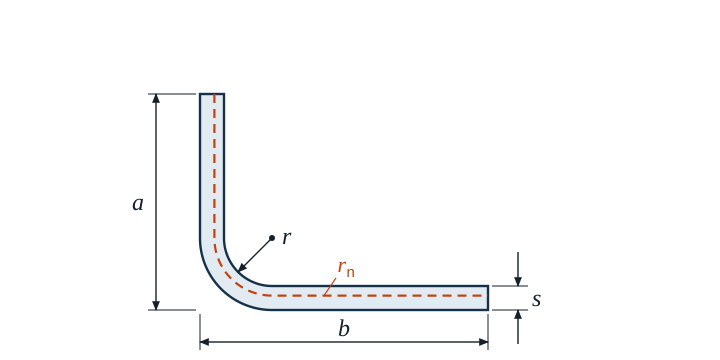
Developed length for a 90° bend
Each straight section is the outside dimension minus the inside radius and the sheet thickness. Add to that the quarter-circle arc of the neutral axis:
Example
An angle bracket made of 2 mm steel sheet with a 4 mm inside radius, outside dimensions 40 mm and 30 mm.
rs = 42 = 2 → k = 0.65 + 0.5 · lg 2 ≈ 0.80
rn = 4 mm + 2 mm2 · 0.80 = 4.80 mm
L = (40 − 6) mm + (30 − 6) mm + π2 · 4.80 mm ≈ 34 mm + 24 mm + 7.54 mm = 65.54 mm
The blank is cut to 65.5 mm. The bend line for the middle of the bend lies 37.8 mm from the edge of the 40 mm leg.
Calculating with the bend deduction
In the workshop, a simpler method is often used: the sum of the outside dimensions minus a bend deduction v per bend. The bend deduction is exactly the difference between the two methods. In the example that is 70 mm − 65.54 mm = 4.46 mm.
Bend deductions for common radii and thicknesses can be found in tables. For any other radius, for inside dimensions or for angles over 90°, you work them out yourself via the neutral axis.
Minimum bend radius and springback
If the bend is too tight, the sheet cracks on the outside. Every material therefore has a minimum bend radius, which grows with the sheet thickness. If the bend line runs parallel to the rolling direction, you need a larger radius than across it.
After bending, the sheet springs back a little and the angle opens up slightly. How much depends on the material, the radius and the thickness. Stronger materials and larger radii spring back more. That is why you overbend slightly and measure the first part.
Common mistakes
- Outside dimensions simply added up: the blank is then too long by the bend deduction.
- Inside and outside dimensions mixed: if a leg is dimensioned on the inside, you only subtract r there, not r + s.
- Neutral axis always assumed to be in the middle: with tight radii this makes the blank too long. In the example it would be 65.85 mm instead of 65.54 mm.
- Bend angle and opening angle mixed up: a part with a 120° opening angle is only bent through 60°.
- Sign of the bend deduction: if v is listed in the table as a positive number, it is subtracted, not added.
- Rolling direction overlooked: if the bend line runs parallel to the rolling direction, the sheet cracks even at radii that still work across it.
Frequently asked questions
Why is it called the “developed length”?
Because it is the length the part would have if you bent it completely straight again – in other words, the length of the blank.
Does the calculation also work for several bends?
Yes. You add up all the straight sections and all the arcs. With the bend deduction, you subtract one v for each bend.