



Not every dimension on a drawing has its own tolerance. If the title block says “ISO 2768-mK”, a general tolerance applies to all dimensions without a tolerance. Here you find out what the letters mean, how to read the table and how much deviation is really allowed on a dimension.
Taking ISO 2768-mK apart
The designation consists of two parts that belong to two different parts of the standard:
- Lower-case letter (f, m, c, v) – tolerance class for lengths, radii, chamfers and angles to ISO 2768-1. The classes range from fine (f) through medium (m) and coarse (c) to very coarse (v).
- Capital letter (H, K, L) – tolerance class for form and position to ISO 2768-2, for example straightness, flatness and perpendicularity.
So “mK” means dimensions in class medium, form and position in class K. In the workshop, m is the most common class.
Permissible deviations for linear dimensions
The permissible deviation depends on the class and the nominal size. The ranges apply “over … up to and including”.
| Nominal size in mm | f (fine) | m (medium) | c (coarse) | v (very coarse) |
|---|---|---|---|---|
| 0.5 to 3 | ±0,05 | ±0,1 | ±0,2 | – |
| over 3 up to 6 | ±0,05 | ±0,1 | ±0,3 | ±0,5 |
| over 6 up to 30 | ±0,1 | ±0,2 | ±0,5 | ±1 |
| over 30 up to 120 | ±0,15 | ±0,3 | ±0,8 | ±1,5 |
| over 120 up to 400 | ±0,2 | ±0,5 | ±1,2 | ±2,5 |
| over 400 up to 1000 | ±0,3 | ±0,8 | ±2 | ±4 |
| over 1000 up to 2000 | ±0,5 | ±1,2 | ±3 | ±6 |
| over 2000 up to 4000 | – | ±2 | ±4 | ±8 |
Deviations in mm.
Radii, chamfers and angles
Radii and chamfer heights have their own, coarser table:
| Nominal size in mm | f and m | c and v |
|---|---|---|
| 0.5 to 3 | ±0,2 | ±0,4 |
| over 3 up to 6 | ±0,5 | ±1 |
| over 6 | ±1 | ±2 |
For angles, the length of the shorter leg is what counts:
| shorter leg in mm | f and m | c | v |
|---|---|---|---|
| up to 10 | ±1° | ±1° 30′ | ±3° |
| over 10 up to 50 | ±30′ | ±1° | ±2° |
| over 50 up to 120 | ±20′ | ±30′ | ±1° |
| over 120 up to 400 | ±10′ | ±15′ | ±30′ |
| over 400 | ±5′ | ±10′ | ±20′ |
Example
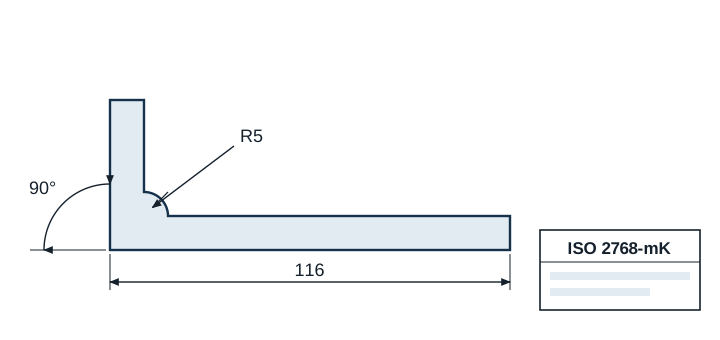
The drawing says “ISO 2768-mK” and has three dimensions without a tolerance. Which values are allowed?
| Dimension | Range | Deviation | allowed |
|---|---|---|---|
| Length 116 mm | over 30 up to 120 | ±0.3 mm | 115.7 to 116.3 mm |
| Radius R5 | over 3 up to 6 | ±0.5 mm | R4.5 to R5.5 |
| Angle 90°, shorter leg 40 mm | over 10 up to 50 | ±30′ | 89° 30′ to 90° 30′ |
Common mistakes
- “mK” read as one class: the lower-case letter applies to dimensions, the capital letter to form and position. Those are two separate tables.
- General tolerance applied to a toleranced dimension: if a dimension has its own tolerance or fit, only that applies.
- Range limit mixed up: the dimension 30 mm still belongs to the range over 6 up to 30; any dimension above that falls into the next one.
- Longer leg used for the angle: it is always the shorter one that counts.
- Radii determined with the length table: radii and chamfers have their own table with larger values.
Frequently asked questions
Is ISO 2768 still valid?
Part 1 for dimensions appears on a great many drawings and is still in use. Part 2 for form and position has been withdrawn, but still applies to existing drawings that specify it. Its successors are ISO 22081 internationally and DIN 2769 in Germany, each with its own classes. Gesello knows ISO 2768 and DIN 2769.
Who decides the class?
The design department. It chooses the class so that the parts work and can still be manufactured economically. In the workshop, whatever is in the title block applies.