



The tap drill formula is quick to work out. For M8, though, it gives 6.75 mm, and hardly anyone has that drill in their set. So 6.8 mm? Or 6.7 mm after all? Here you find out why both neighbours work, why 6.8 mm has become the standard and where the limit lies beyond which the thread is no longer right.
Where the 6.75 mm comes from
For metric ISO threads, the well-known rule of thumb for tapping is: nominal diameter minus pitch. M8 has a coarse pitch of 1.25 mm.
dB = 8 mm − 1.25 mm = 6.75 mm
How to find the tap drill for any thread is explained in detail in the calculation guide Tap drill size for threads. This article is about the next question: how closely does the drill actually have to match the formula?
The tap drill hole has a tolerance
The formula does not give an exact target value, but a convenient value in the middle of a permitted range. The minor diameter D1 of an internal thread is toleranced. For the usual tolerance class 6H, this range applies to M8.
| Minor diameter M8, tolerance class 6H | mm |
|---|---|
| Minimum size D1 min | 6,647 |
| Maximum size D1 max | 6,912 |
| Tolerance | 0,265 |
The minimum size is also the smallest minor diameter the thread profile allows. The hole must not be smaller. But it must not be larger than the maximum size either, otherwise the thread is no longer within tolerance. Anything in between is fine. The three candidates 6.7 mm; 6.75 mm; 6.8 mm all sit comfortably inside.
What 0.05 mm does to the thread
The difference between 6.7 mm and 6.8 mm looks tiny. In the thread it shows up as thread engagement, the share of the load-bearing profile height that the nut thread and the bolt thread have in common. At 6.647 mm it is 100 %. The larger you drill, the more the threads in the workpiece are missing at the crest.
- d nominal diameter in mm
- dB tap drill diameter in mm
- H1 flank overlap of the basic profile in mm, H1 = 0.5413 · P
For M8, H1 = 0.5413 · 1.25 mm ≈ 0.677 mm. This gives the following overview.
| Drill in mm | Engagement | Rating |
|---|---|---|
| 6,6 | over 100 % | too small, below the minimum size |
| 6,7 | 96 % | fine, the tap runs harder |
| 6,75 | 92 % | fine, exactly the formula value |
| 6,8 | 89 % | fine, the usual choice |
| 6,9 | 81 % | just below the maximum size, no reserve |
| 7,0 | 74 % | too large, above the maximum size |
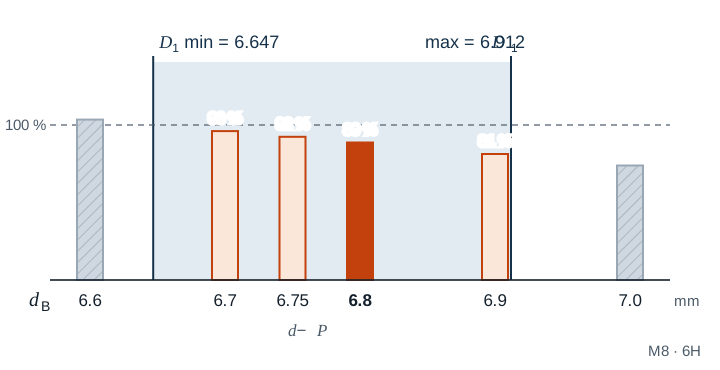
The percentages are calculated from the drill diameter. In practice the hole usually ends up a few hundredths larger than the drill because it cuts slightly oversize. At 6.9 mm that can already be enough to go beyond 6.912 mm.
Why 6.8 mm is the standard
- The drill is everywhere. Above 4 mm, drill sets usually come in 0.1 mm steps. A 6.75 drill does exist, but it is rarely in the cabinet.
- The tap is spared. With the larger hole it removes less material. That lowers the cutting torque and with it the risk of the tap breaking.
- The load capacity stays almost the same. At around 90 % engagement and sufficient engagement length, the screw is more likely to fail than the thread to strip. The last few percent up to full engagement add hardly any holding power, but cost considerably more force on the tap.
That is why Gesello also rounds to the usual drill step in such tie cases. If the formula ends in 0.75, it rounds up; if it ends in 0.25, it rounds down. This gives 6.8 mm for M8 and 10.2 mm for M12.
When 6.7 mm is the better choice
With thin sheet or short threads, every load-bearing millimetre of flank counts. Then the smaller hole pays off, as long as the material machines well, such as free-cutting steel, brass or grey cast iron. With tough materials such as stainless steel or copper, on the other hand, stick with 6.8 mm. There the tap pushes material into the profile crests, the hole closes up during cutting and the tap jams sooner. These recommendations are guide values; the tool manufacturer’s data and the drawing take precedence.
Example
An M12 × 1.25 thread is to be cut in a plate made of S235JR. The formula gives
dB = 12 mm − 1.25 mm = 10.75 mm
The basic profile is the same as for M8, because both threads have a pitch of 1.25 mm. The minor diameter can therefore again have a tolerance of 0.265 mm and lies between 10.647 mm and 10.912 mm. The value ends in 0.75, so it is rounded up. Drill with 10.8 mm; the engagement is again around 89 %.
Common mistakes
- Drilled to the minor diameter: anyone who reads 6.647 mm as the drill size and reaches for 6.6 mm ends up below the minimum size. The tap cuts heavily and breaks easily.
- Drilled larger to be safe: a 7.0 mm hole is no longer a comfortable hole for M8, it is scrap. The screw holds noticeably less.
- Drill not checked: a worn or poorly ground drill cuts more oversize. For threads with a tight tolerance, measure the drill first.
- Forming tap value mixed up: thread forming taps need larger pre-drill sizes. The considerations for cutting cannot be transferred.
Frequently asked questions
Does the thread plug gauge also check the tap drill hole?
Only to a limited extent. The go and no-go ends of the thread plug gauge mainly check the flanks. A tap drill hole that is too small shows up while tapping, one that is too large often goes unnoticed with the thread plug gauge. If the minor diameter has to be verified, check it with a plain plug gauge or an internal measuring instrument.
Does the tolerance also apply to M8 × 1?
No. The minor diameter tolerance depends on the pitch. For M8 × 1 the tap drill according to the formula is 7.0 mm, and the permitted range is narrower than for a pitch of 1.25 mm.
How do I get the value quickly at the machine?
With Gesello in the Threads module. You select the thread, the app shows the right tap drill for cutting and forming and works out the drilling depth for you too.