




You reach into the bolt box and pull out an M8 that looks exactly like the one you want to replace. Whether it holds just as much, only the head can tell you. A few characters there show who made it and how strong it is. Here you learn to read those marks and how much the classes really differ.
What has to be on the head
Many steel bolts with metric thread carry two markings from 5 mm thread diameter upwards, as long as their shape allows it.
- Manufacturer's mark: letters or a symbol. It shows who vouches for the values.
- Property class: two numbers with a dot, for example 8.8 or 10.9.
For hexagon head bolts this applies to all classes from 4.6 to 12.9. For cap screws with hexagon socket or hexalobular socket, marking is only mandatory from 8.8 upwards. The marks are usually embossed or indented on the top of the head, on cap screws also on the side of the head. Below M5, often only the packaging helps.
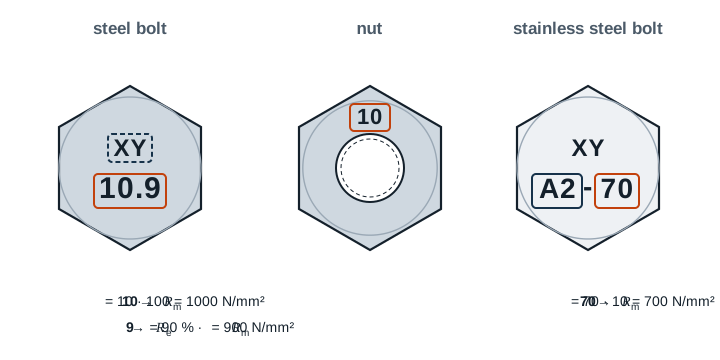
Reading the two numbers in ten seconds
The first number times 100 is the tensile strength, the stress at which the bolt breaks. The second number divided by 10 tells you what share of it is the yield strength. Above that, the bolt stretches permanently.
- a first number of the property class, b second number
- Rm tensile strength in N/mm²
- Re yield strength in N/mm², from 8.8 upwards strictly speaking the 0.2 % proof stress Rp0.2
For 12.9 that means 1200 N/mm² tensile strength and 90 % of it as yield strength, i.e. 1080 N/mm². A 4.6 only reaches 400 N/mm², and at just 60 % of that, i.e. 240 N/mm², it already starts to stretch permanently. Classes ending in 6 are tough, classes ending in 9 hold a lot but have little reserve before fracture.
How big the difference really is
It becomes more tangible with the force at which the bolt stretches permanently. What counts here is the tensile stress area As of the thread. For M8 that is 36.6 mm².
- Fe tensile force at which the bolt reaches its yield strength, in N
- As tensile stress area in mm²
Example
A fixture is missing an M8 socket head cap screw of class 8.8. In the box there is a screw without marking and a stainless steel one marked A2-70. How much does each one hold up to its yield strength?
8.8 → Fe = 640 N/mm² · 36.6 mm² ≈ 23.4 kN
A2-70 → Fe = 450 N/mm² · 36.6 mm² ≈ 16.5 kN
no mark, assumed 4.6 → Fe = 240 N/mm² · 36.6 mm² ≈ 8.8 kN
The stainless steel screw manages only about 70 % of the 8.8. For the screw without a mark you assume the worst, which leaves just over 37 %. Up to its yield strength the 8.8 carries roughly as much as a weight of 2.4 t, the unknown screw perhaps only 0.9 t. So neither replacement is a good idea here.
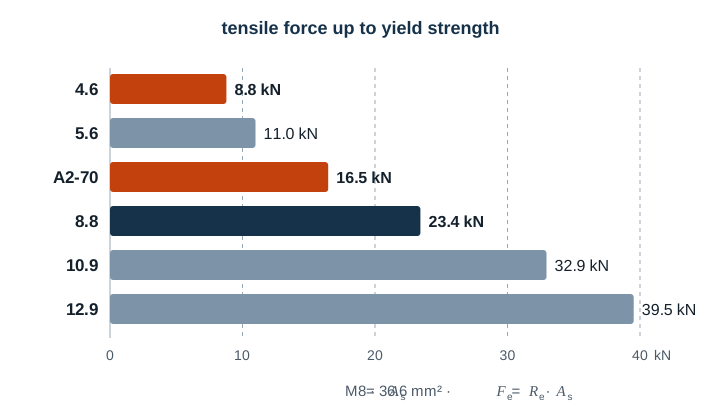
The values are for comparison only. What a bolt may carry in service is set by the design. For tightening you will find guide values in the calculator Tightening torque for bolts.
Nuts and stainless steel
Nuts have just one number, for example 8, 10 or 12. From M5 upwards it is indented on the side or bearing face or embossed on the chamfer. Instead of the number there may also be a code using the clock-face system. The rule is simple. The nut's number must be at least as high as the first number of the bolt. An 8.8 takes a nut of class 8 or higher, a 10.9 a class 10 or higher.
Stainless steel reads differently. In A2-70, A stands for the steel group, austenitic steel, and A2 or A4 for the steel grade. A4 also contains molybdenum and is more resistant to chlorides, for example in salt water or swimming pools. The number after the hyphen times 10 gives the tensile strength, so 700 N/mm² for A2-70. The yield strength cannot be read from it. Stainless steel bolts without a class on the head often only reach class 50.
What the head doesn't tell you
- The colour: many 12.9 socket head cap screws are black, but black does not mean 12.9. Zinc-plated bolts also come in almost every class.
- The thread direction: bolts with left-hand thread should carry an extra mark from M5 upwards, but don't rely on it. Hold the bolt upright and look at the thread. On a right-hand thread the turns rise to the right, on a left-hand thread to the left.
- The condition: an overstretched bolt carries the same marking as a new one. If the shank is necked, it belongs in the scrap bin.
Common mistakes
- Stainless steel fitted where 8.8 was required: A2-70 sounds like more, but up to its yield strength it holds only about 70 % of an 8.8.
- Bolt without a mark fitted: a hexagon head bolt from M5 upwards without a class on the head is not a standardized steel bolt with proven strength. Treat it like the weakest class or use another one.
- Forgot the nut: a 10.9 with a class 8 nut can fail at the nut thread before the bolt carries its full load.
- Swapped 8.8 for 10.9 without checking: stronger is not always better. Higher-strength bolts are less ductile, and electroplated zinc bolts from 10.9 upwards can become brittle due to hydrogen. What is required is shown on the drawing.
Frequently asked questions
Can I replace an 8.8 with a 10.9?
For strength usually yes, if the nut matches too. Tighten with the torque specified for the joint. Use the higher torque of a 10.9 only if the component, thread engagement length and bearing surface can take it. Electroplated zinc 10.9 only with approval. If the drawing explicitly calls for 8.8, for example because the bolt is meant to give way first under overload, stick with 8.8.
What do I do if the marking is no longer readable?
Then the class is unknown, even if the bolt comes from a good box. For load-bearing joints, use a new, marked bolt.
Where do I find this in the app?
In Gesello in the Screws module. In the Strength tab you choose a class and see tensile strength, yield strength and the matching nuts, for stainless steel too. In the Designation tab the app breaks an order designation such as ISO 4017 - M12x60 - 10.9 down into its parts.